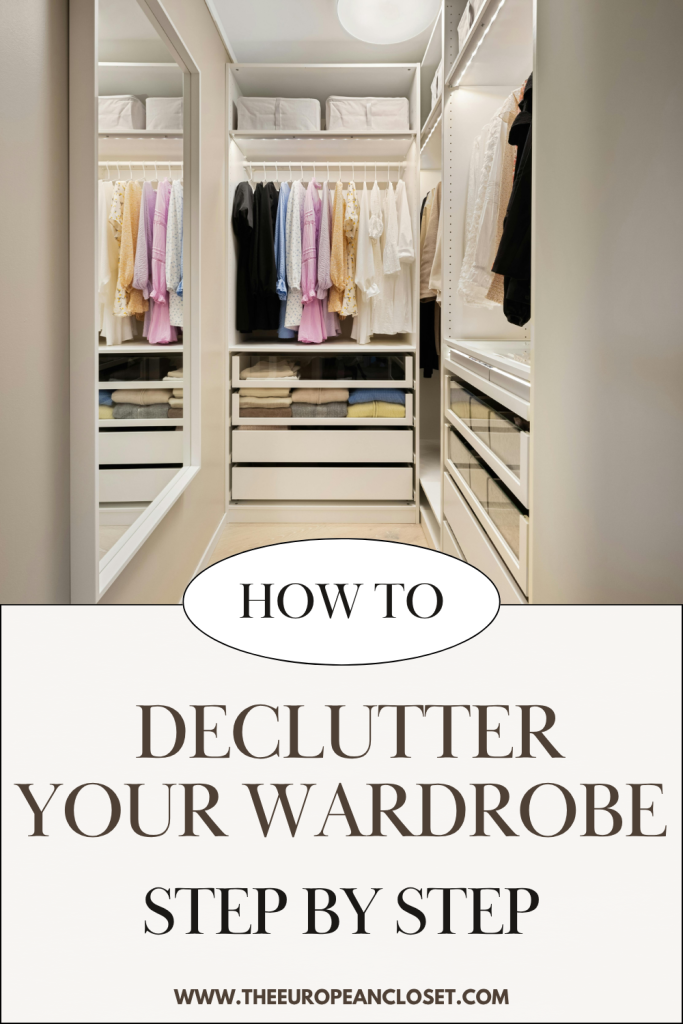
Looking for the best tips on how to actually declutter your wardobre without having any regrets later? You’ve just stumbled upon the right article.
I have made some very bad wardrobe decluttering decisions over the years.
There was a silk blouse I donated during one of those “right, enough is enough, everything is going” Sunday clear-outs. I hadn’t worn it in ages, so obviously I decided that meant I didn’t need it anymore.
Except I thought about that blouse constantly afterwards.
Six months later, I was still thinking, why did I get rid of that?
Then there was a pair of wide-leg pants that I got rid of because they didn’t fit quite right. Looking back, they didn’t need to be donated. They needed about 1-hours worth of alterations.
These are the sorts of things that make me slightly suspicious of the classic decluttering advice of “if in doubt, throw it out.”
Because sometimes you are in doubt for a reason.
I am all for having a wardrobe that is organized, intentional and actually wearable. I don’t want to open my wardrobe every morning and feel like I have nothing to wear despite it being completely full. And I definitely don’t want clothes I never wear taking up all the space.
But I also don’t believe that the goal of a wardrobe declutter is to get rid of as much as possible.
You don’t get a prize for filling the biggest donation bag.
The goal is to end up with a wardrobe that makes sense for your actual life: your style, your body, your routine and the things you genuinely enjoy wearing.
And once I started looking at decluttering that way, I stopped making quite so many regrettable decisions.
So, if you’re thinking about giving your wardrobe a proper clear-out, here’s how I would actually do it.
Before You Start: Stop Thinking About What You’re Getting Rid Of
I think this is the biggest mindset shift.
Most wardrobe decluttering advice starts with“What can I throw away?” And I don’t think that’s the right question.
Instead, ask yourself: “Does this belong in the wardrobe I want to have?” because those are two completely different questions.
Maybe you have a dress you haven’t worn in six months but you absolutely love and know you’ll wear next summer. Keep it.
Maybe you have a pair of jeans you’ve owned for five years and have never once felt good in. They should probably go.
Maybe you have a blazer you love but it needs the sleeves shortened. That doesn’t need to go anywhere, it just needs a trip to the tailor.
And maybe you just don’t know yet and that’s allowed too. You don’t need to make a decision about every single piece of clothing while standing in the middle of your bedroom surrounded by piles of clothes.
Step 1: Take Everything Out
Yes, everything. I know this sounds dramatic, but if you’re going to do this properly, you need to actually see what you have.
Take everything out of your wardrobe, drawers, random storage boxes, the chair that has slowly become a second wardrobe (you know the one) and don’t forget the things you’ve pushed right to the back because you haven’t worn them in approximately three years.
This is usually the point where I discover about five things I completely forgot I owned, and honestly, that’s one of the biggest reasons I think wardrobe decluttering is useful.
Sometimes you don’t need to buy anything new. You just need to remember what you already have.
You’ll probably find something you used to love. Something you bought because it was on sale. Something you have absolutely no memory of buying. Something you’ve been saving for “the right occasion” since 2021. It all needs to come out.
But here’s the important part: Don’t start throwing things away yet.
First, just look at everything.
Step 2: Create Four Piles
I, personally, am not a fan of the classic “keep or donate” method because, frankly, clothes are more complicated than that.
Instead, I like four categories.
Definitely Keeping
These are the easy ones.
Your favourite jeans, the blazer you wear constantly, the dress you always get compliments on. Basically, anything you wear regularly, feel good in and would be annoyed to lose.
Don’t overthink these. Put them back.
Definitely Going
This pile should also be relatively easy.
Things that don’t fit and haven’t fit for years, things you don’t like anymore, things that are damaged beyond repair, things you’ve owned forever and have never worn, things you put on and immediately think “absolutely not.”
Time to say goodbye.
Needs Attention
This is the pile I think most people forget about because sometimes the problem isn’t the clothes, it’s the fit.
Maybe those pants are too long, the waist needs taking in, a button has fallen off.
Maybe the dress needs dry cleaning. Maybe the blazer would be perfect if the sleeves were slightly shorter.
Don’t donate something you love just because it isn’t currently wearable.
Write down what needs doing and actually get it done.
Otherwise, we both know what’s going to happen: it’s going back into the wardrobe and staying there for another two years.
Not Sure
Ah, the dangerous pile.
These are the pieces you’re holding up thinking “I don’t know, maybe?”
Put them down, you don’t have to decide.
This is exactly where I think people get into trouble because they convince themselves that a declutter means making a decision about every item immediately, but it doesn’t.
Step 3: Give Your “Maybe” Clothes Some Time
If you’re genuinely unsure about something, put it in a box or storage bag, somewhere out of sight but not completely inaccessible.
Then leave it there for three months.
If you suddenly remember that specific skirt and think, “I really want to wear that,” take it back out. But if three months go by and you haven’t thought about any of it? That’s pretty useful information.
And please don’t open the box halfway through just to have a look.
I know the temptation, you’ll open it, see an old dress you wore on holiday in 2022 and suddenly convince yourself that you absolutely need it.
The whole point is to see what you naturally miss, not what you can convince yourself to keep once it’s sitting in front of you again.
Step 4: Ask Yourself Better Questions
When you’re standing there holding something and genuinely cannot decide, these are the questions I would ask.
Do I actually wear this?
Not “Could I wear this?”, “Could I make an outfit with this?”
And definitely not “Maybe I’ll wear it this summer.”
Do you actually wear it? Because I can create approximately 17 outfits in my head for something I will never actually put on my body.
There’s a difference between something looking good on a Pinterest board and something you genuinely want to wear.
Does it fit me right now?
This one can be difficult, but ask yourself honestly: does it fit you today?
Not when you lose weight, not when your body changes, not when you go back to the size you were two years ago.
If you’re keeping something because you’re hoping it will fit someday, that’s a completely different decision from keeping something you genuinely wear now.
And if you do want to keep it for sentimental or practical reasons, that’s fine. Just be honest with yourself about why it’s staying.
Is the problem actually fixable?
This is where my pants from earlier come in.
If the problem is a hem, button, zip, sleeve length or small alteration, don’t automatically get rid of the item, but if the problem is that you hate the color every time you see it or you never feel comfortable in the shape, that’s probably not something a tailor is going to solve.
Would I buy this again today?
This is probably my favourite question.
Imagine you’re walking into a shop and you see the exact same piece, would you buy it?
Not because it was expensive, it was on sale or you spent ages looking for it.
Would you actually hand over your money for it today? If the answer is no, listen to that.
Am I keeping this because I feel guilty?
This one is a big one.
Maybe it was expensive, a gift, you only wore it once, someone gave it to you and you’ll feel terrible getting rid of it.
But keeping something you don’t want doesn’t magically make the original purchase worthwhile.
The money has already been spent and you are allowed to let go of things.
Your wardrobe is not a museum for every bad purchase you’ve ever made.
Step 5: Think About Where Your Clothes Are Going
Once you’ve decided something is leaving, I think it’s worth giving a little thought to where it’s going.
If it’s in good condition, try selling it. I’ve sold plenty of clothes on Vinted over the years and while yes, photographing everything, writing descriptions and packaging parcels isn’t exactly my idea of a wild Saturday night, it can be worth it.
Clothes swaps are another really good option. Get a few friends together, bring things you’re no longer wearing and swap them. Someone gets a new piece without spending money, you get something new-to-you and the clothes actually get worn.
And then there’s donating.
If you’re donating, have a quick look at what local charities and organizations actually need rather than just throwing everything into the nearest donation bin.
And please don’t donate clothes that are completely ruined, if you wouldn’t give it to a friend, don’t assume a charity wants it.
For things that genuinely can’t be worn anymore, look into textile recycling instead.
And once you’ve made the bag, get it out of your house. Don’t leave it beside the front door for six months.
I am speaking from experience here. Give yourself a deadline and actually take it somewhere.
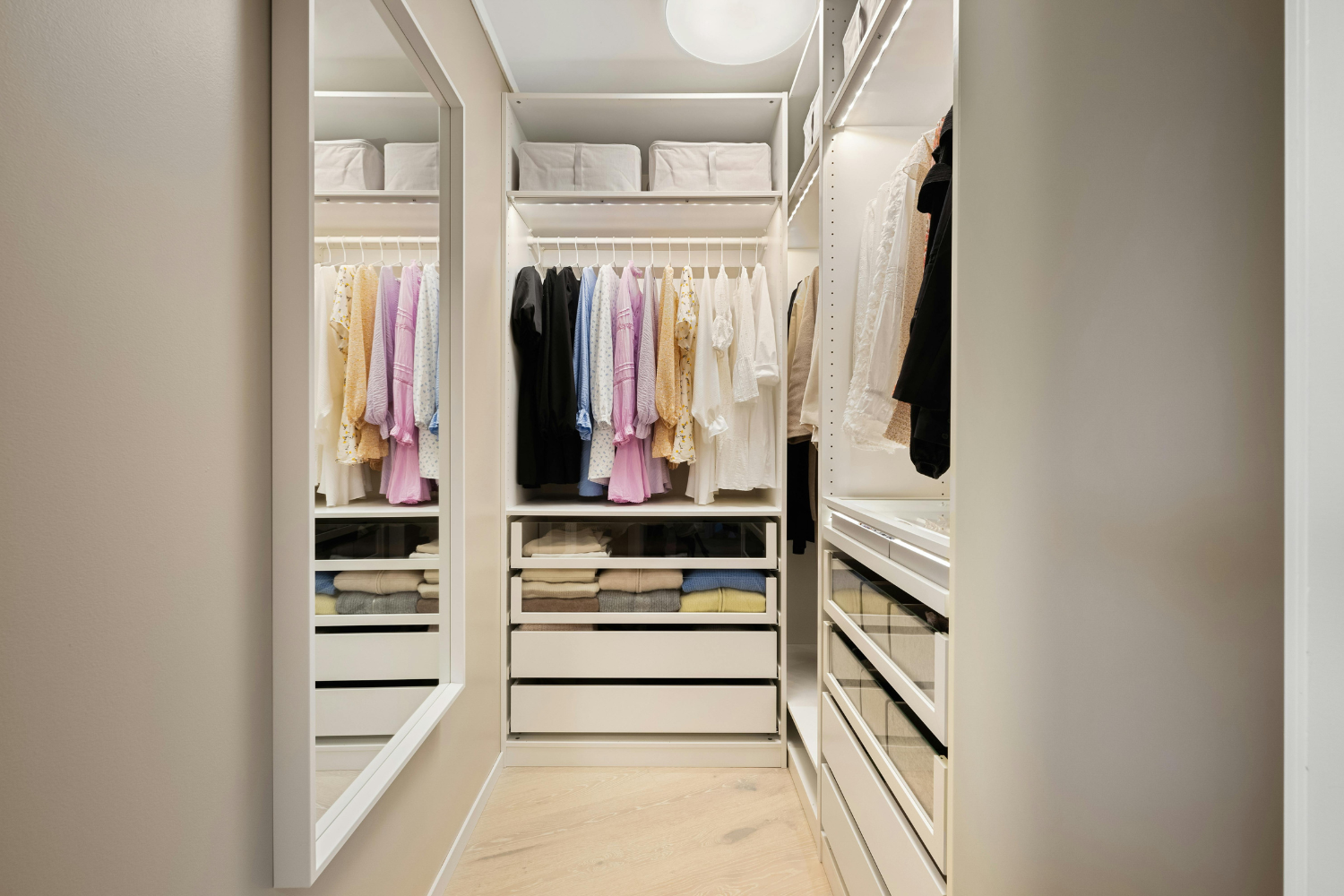
Step 6: Put Everything Back in a Way That Makes Getting Dressed Easier
Now for my favourite part: putting everything back.
You don’t need one of those perfectly color-coordinated wardrobes that looks like it belongs in a showroom.
Although, admittedly, I do think color-coordinating your clothes makes things much easier to find.
But the main thing is making your wardrobe work for you.
Keep Similar Things Together
Pants with pants, shirts with shirts, dresses with dresses, blazers with blazers.
I personally find this much easier than separating everything into “work”, “casual”, “going out” and “holiday”.
Because most clothes aren’t actually that specific.
A blazer can be worn to work with tailored pants or on a Sunday with jeans. A dress can be worn to dinner or dressed down with sneakers.
I want to see the options, not put everything into little boxes.
Keep Your Most-Worn Pieces Where You Can See Them
This sounds obvious, but if you wear something three times a week, don’t hide it behind the dress you wear once every six months.
Keep the things you reach for constantly somewhere easy to see. It makes getting dressed quicker and, honestly, it makes it much more likely that you’ll actually wear the rest of your wardrobe too.
Give Your Clothes Some Breathing Room
This is one of those things you don’t realise makes a difference until you’ve done it.
If your wardrobe is completely packed, you can’t see anything properly. You end up wearing the same five things because they’re the five things you can actually reach.
Leave a little space between things. Your wardrobe doesn’t need to be stuffed to the absolute limit.
A Few Things I’ve Learned About Decluttering
You Don’t Need to Do Everything in One Day
Please don’t wait for one Saturday when you have six free hours and decide you’re going to completely transform your wardrobe.
You’ll start enthusiastically, then you’ll get tired. Then you’ll start making questionable decisions. Then you’ll end up sitting on the floor surrounded by clothes wondering why you ever started.
Ask me how I know.
Do one category at a time if that’s easier. It doesn’t have to happen all at once.
You Don’t Need a Capsule Wardrobe
I love a capsule wardrobe in theory. But I don’t think everyone needs to own 30 pieces of clothing.
Some people genuinely love having a smaller wardrobe. Other people love fashion and want options.
Neither is wrong.
Your wardrobe doesn’t need to fit into someone else’s definition of minimalism. It needs to fit into your life.
Your Wardrobe Will Change
You might love something now and not love it next year.
Your lifestyle might change, your style might change, you might move somewhere with a completely different climate.
Your wardrobe is allowed to change with you so don’t think of decluttering as something you do once and then never have to think about again.
I like doing a proper wardrobe check every six months or so. Nothing dramatic. Just a little reset to see what’s actually getting worn.
The Goal Is to Make Getting Dressed Easier
This is really the whole point.
After you’ve finished, you should open your wardrobe and feel like you have options.
You should know what you own. You should know what you actually like wearing. And you should be able to put an outfit together without feeling like you’re solving a maths problem at 8am.
If you finish your declutter and still feel overwhelmed, don’t immediately assume you need to get rid of more.
Maybe you’re still keeping too much, or maybe you’ve gotten rid of the wrong things or maybe you’re actually missing a few really useful basics.
Decluttering isn’t just about what needs to leave.
It’s also about understanding what your wardrobe is missing.
Want to Start Today? Do This
If the idea of pulling your entire wardrobe apart feels overwhelming, don’t.
Start small.
Today, get rid of:
- Anything that’s visibly damaged and you’ve been saying you’ll fix for over a year.
- Anything that doesn’t fit properly right now and you don’t realistically want to keep.
- Anything you’ve owned for two or more years and have genuinely never worn.
- Anything you’re only keeping because you feel guilty.
And then stop.
The point isn’t to own as little as possible, it’s to open your wardrobe and actually like what’s in there.
And, ideally, avoid donating another silk blouse you’ll spend the next six months wishing you still had.
If you liked this post, you might also like:
- The Ultimate Spring Declutter Checklist: 250 Things You Should Declutter Right Now
- The Only Digital Declutter Checklist You’ll Ever Need
- End of Summer Reset Routine: How To Reorganize Your Life
FOLLOW ME:
INSTAGRAM | PINTEREST